

Summer 2022 Water Quality Sampling Results Available
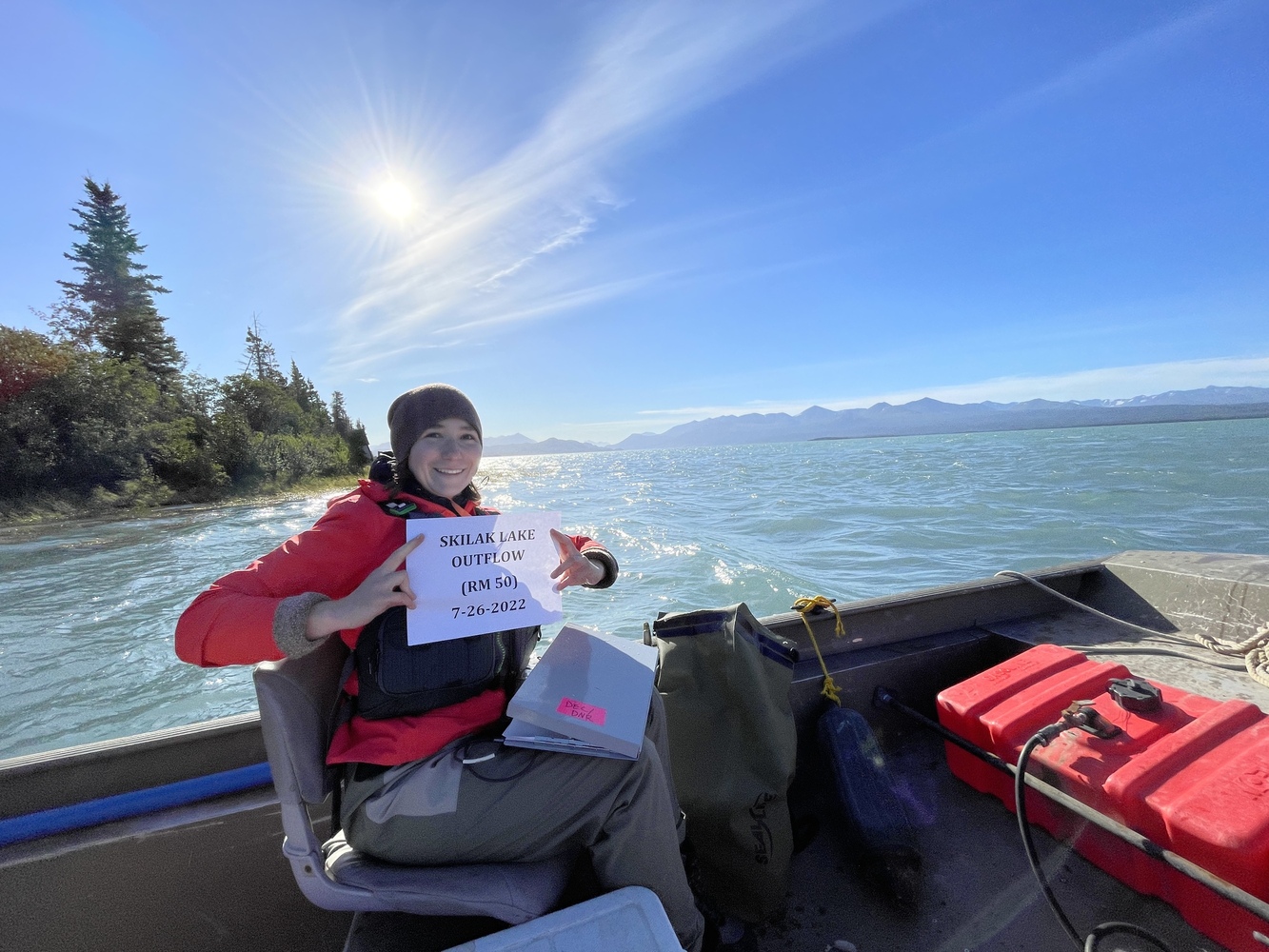
October 18, 2022Kenai Watershed Forum has received all laboratory results from it’s Summer 2022 Baseline Water Quality Monitoring. The results are currently being prepared for upload to the Environmental Protection Agency’s Water Quality Exchange, a pubic data repository for water quality data. The results have not yet been analyzed to check against water quality standards; we expect to complete this by Summer 2023.
We worked with three laboratories in Summer 2022:
1.) Soldotna Wastewater Treatment Plant – SWWTP provided analyses of Total Suspended Solids:
Download Summer 2022 Total Suspended Solids results
2.) Tauriainen Engineering and Testing – Tauriainen provided analyses of Fecal Coliform
Download Summer 2022 Fecal Coliform results
3.) SGS Laboratories, Anchorage – SGS provided analyses of all other substances monitored in Spring 2022, including nutrients like phosphorus and nitrogen, and metals like zinc, copper, lead, and others:
Download Summer 2022 Metals and Nutrients results
For questions about Summer 2022 water quality results, contact Benjamin Meyer, Water Quality Coordinator. Thank you again to all the participants and volunteers who made this event happen!
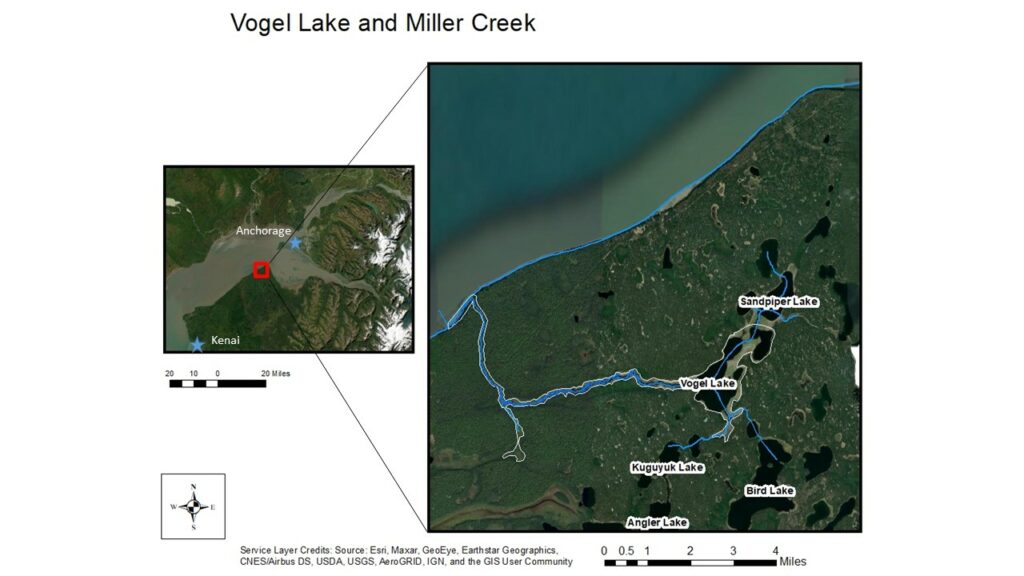
Vogel Lake and Miller Creek Hydrology
October 10, 2022In Fall 2019, the Alaska Department of Fish and Game (ADF&G) were notified of several adult pike caught in Vogel Lake near the Northwest tip of the Kenai Peninsula. Pike are a non-native fish species of great concern in south central Alaska, as they are voracious predators of juvenile salmonids when given the opportunity (see Dunker et al 2018 for a summary). Several watersheds in the nearby Mat-Su valley have seen pike colonize and nearly take over, with local managers making herculean efforts to slow their spread.
The Kenai Peninsula has thus far managed to escape the fate of the Mat-Su valley in terms of pike invasion. Pike were found in a number lakes and creeks in the Kenai/Soldotna area in the early to mid 2000’s, but were quickly contained and exterminated. In the case of Miller Creek, researchers believe that at least one or multiple pike arrived by swimming over from the Mat-Su through the Cook Inlet, likely during the Spring when high runoff levels create temporarily lowered salinity levels.
With the news that pike had arrived to Vogel Lake, local mangers reacted swiftly. Kenai Watershed Forum worked with ADF&G personnel in developing a proposed treatment plan, then applied for and received a grant from the National Fish and Wildlife Foundation to support the work. KWF took the role of addressing project water quality monitoring and mapping before, during, and after the treatment process.
As of Fall 2022, evidence indicates the project has been successful in eliminating pike from the watershed. After treatment with the chemical rotenone in Fall 2021, subsequent monitoring in Summer 2022 has failed to capture pike, and the system is repopulating with native fish from adjacent lake systems.
To access Kenai Watershed Forum’s work on water quality and mapping efforts for this project, see the online report at the following link: Miller Creek and Vogel Lake Water Quality Report.
The report is best accessed in the online format linked above, but a static MS word document with the same information may be downloaded here also.
The Kenai Peninsula remains pike-free for the moment. The future of keeping it that way will depend on a combination of monitoring, research, and education. Local researchers and managers are continuing to monitor areas vulnerable to potential invasion, as well investigating salinity tolerance in pike found in south central Alaska.
One future valuable addition to prioritizing pike monitoring efforts for the Kenai Borough region would be to replicate the approach outlined by researchers who created a map of “vulnerability” to pike invasion for the Mat-Su valley (Jalbert et al. 2021). “This simple to implement, adaptable, and cost-effective framework will allow prioritizing habitats for early detection and monitoring of invading northern pike,” the authors write. Such tools would be highly useful for on-the-ground biologists in our region, tasked with surveying a large and remote area for invasive pike.
As long as pike are our distant neighbors, there’s the potential for them to visit again any time, and it’s our responsibility to be ready.
References
Dunker, K., Sepulveda, A., Massengill, R., and Rutz, D. 2018. The Northern Pike, A Prized Native but Disastrous Invasive. In Biology and Ecology of Pike. CRC Press. pp. 356–398. https://bit.ly/3V9Wp38. [accessed 10 October 2022].
Jalbert, C.S., Falke, J.A., López, J.A., Dunker, K.J., Sepulveda, A.J., and Westley, P.A.H. 2021. Vulnerability of Pacific salmon to invasion of northern pike (Esox lucius) in Southcentral Alaska. PLoS One 16(7): e0254097.
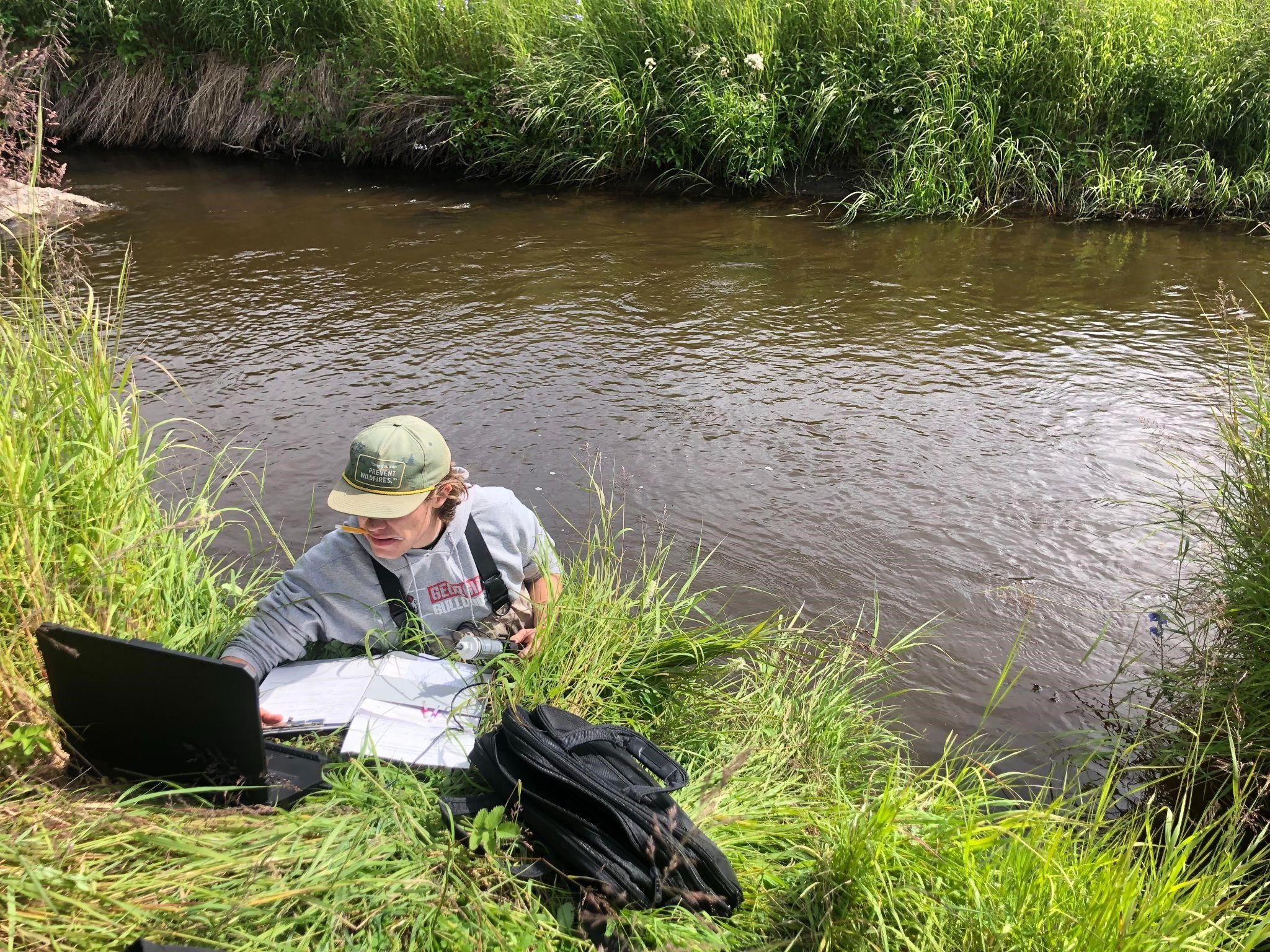
Jack Buban (KWF Intern 2021)
August 22, 2022The summer (and ensuing fall) that I spent working with KWF proved to be the most influential period of my life both professionally and personally. Being surrounded by people so inspired to work for a resource that means so much to this ecosystem, economy, and the culture of this area shed some hope onto the impact that a small motivated group of people can have on an area they care about.
From a purely professional standpoint I developed more skills in the few months that I spent in Soldotna than I had in years prior. Performing extensive GIS projects, intense field work, grant writing, and gaining an understanding of how to work with people to maximize effectiveness (and maintain sanity) spurred my career development far more than any other job/internship I had previously had. Equally as important to all of that however, is the growth as a person I experienced. The people that I met (and you’ll have the pleasure of working with) are the warmest I’ve interacted with in my entire life and recognize the struggles that can come with being thousands of miles from home. The sense of community on the Kenai Peninsula is unlike anything I’ve experienced before, and allowed me to grow as a person in a highly transitional time in my life.
Working as an intern for the Kenai Watershed Forum shaped who I am today, as well as what I am looking for in the future. It provides the opportunity to do work that matters with good people, and frankly, for me, there’s not much out there that can top that.
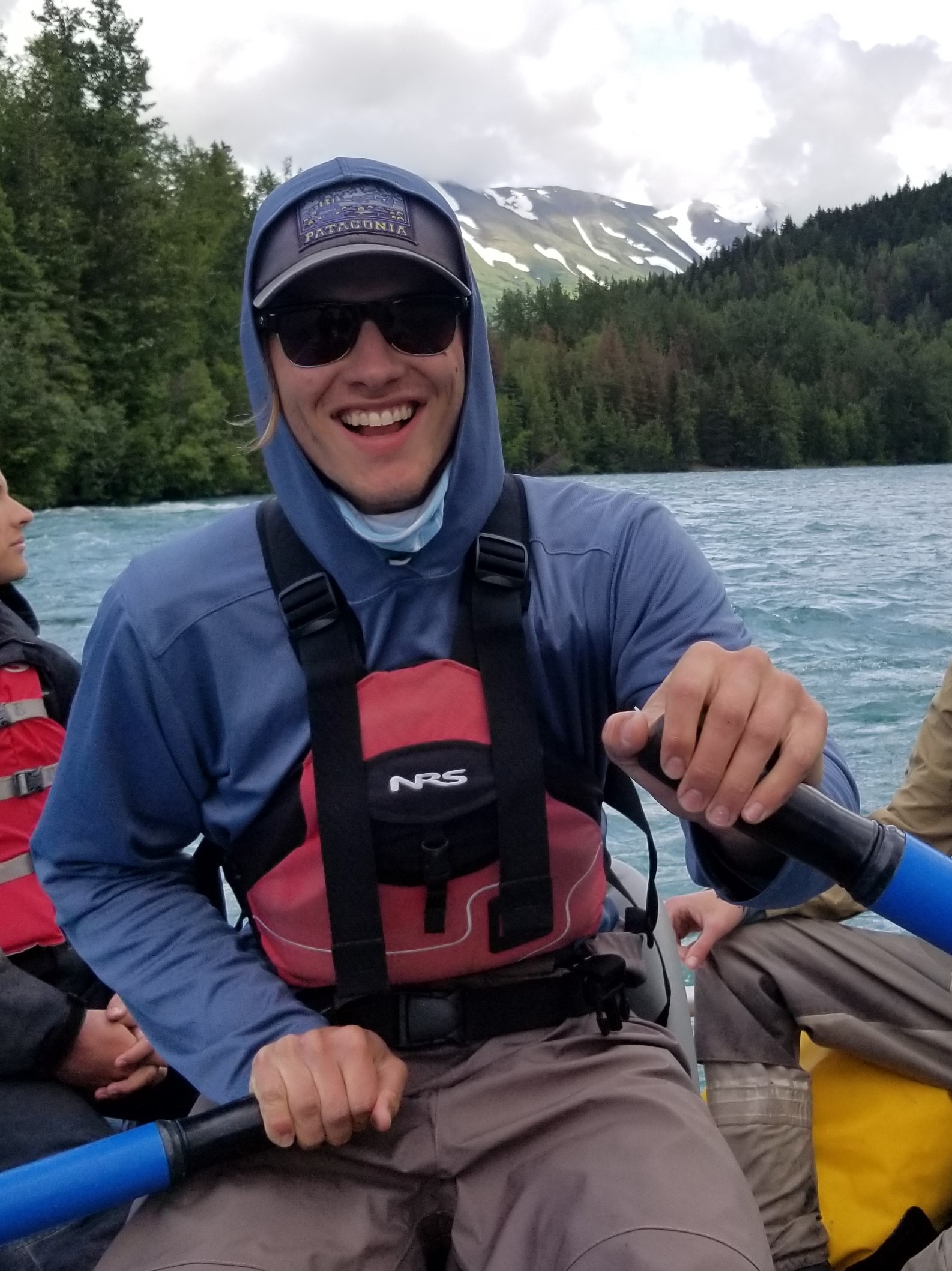
Burke Haywood (KWF Intern 2021 & 2022)
July 25, 2022My first summer interning with the Kenai Watershed Forum (KWF) was easily the most impactful and enjoyable work experience I have ever had and – like many interns before me – I enjoyed it so much that I returned for a second summer. During my time at KWF I’ve had the opportunity to work alongside a small team of incredibly determined and self-motivated individuals on a wide variety of exciting projects. Some of my favorite things about working for KWF include: getting to collaborate with a slew of different people, conservation agencies and organizations; interacting with locals who have a deep appreciation for the work we do; imparting the things I learned at work to curious kids at our summer camp; and, of course, the opportunity to see and explore the beautiful Kenai Peninsula while at work.
One particular project – controlling an extensive infestation of invasive white sweet clover on the Seward Highway – has stuck with me and encapsulates much of what I have grown to love about working at KWF. It was late in the summer and the rest of the invasive crew and I had been working around the clock to control the spread of invasive plants all over the peninsula. As my time in Alaska waned and the season of growth – where invasive plants seemed to pop up like a whack’a’mole – came to a close, the summer had begun to feel like a job well done. But, as we drove up the Seward Highway to what should have been a routine day of treating small infestations of bird vetch and meadow hawkweed in Portage, we spotted the mother of all white sweet clover infestations.
Broad tendrily bushes, some up to 5-6 feet high, adorned with little white flowers as far as the eye could see. My team and I sat aghast as we continued a mile, then two miles, before seeing a break in the dense infestation. In all my days of pursuing plant species in places they don’t belong, I had never seen such an intense monocrop – a prime example of the detriment to biodiversity that our work aims to prevent.
Doing her best to keep her composure, my fearless supervisor, Invasive Species Program Coordinator, Maura Schumacher, considered our options for managing this infestation that I felt sure had grown far beyond something that we, with our few hands, had any chance to control. We couldn’t mow it because the plants were so mature that they probably already bore viable seeds. We couldn’t treat it with herbicide because our permits didn’t allow us to spray there and by the time we secured a permit, the plants would have already gone to seed. The only option was hand-pulling, but with our little crew of three, it would’ve taken many days, even weeks, to hand pull and bag such a prolific infestation. We had to call for backup!
Overnight, emails were sent and phone calls were made, and by the following day, a large group of people from 6 different agencies and organizations dawned their orange traffic vests and assembled to tackle this beast. Coaxed on by the spectacular mountain vistas around us and unbothered by the constant racket of vehicles whizzing by, we pulled one plant after another for an entire day. By the end of it all, six dumpsters had been filled with bags of white sweet clover and to our knowledge, that section of highway had been rid of every last one of the unwelcome invaders. With tired hands and sore backs we momentarily reveled in our accomplishment and then headed home to our various corners of the peninsula where we could all rest assured that the day had been one heck of a job well done.
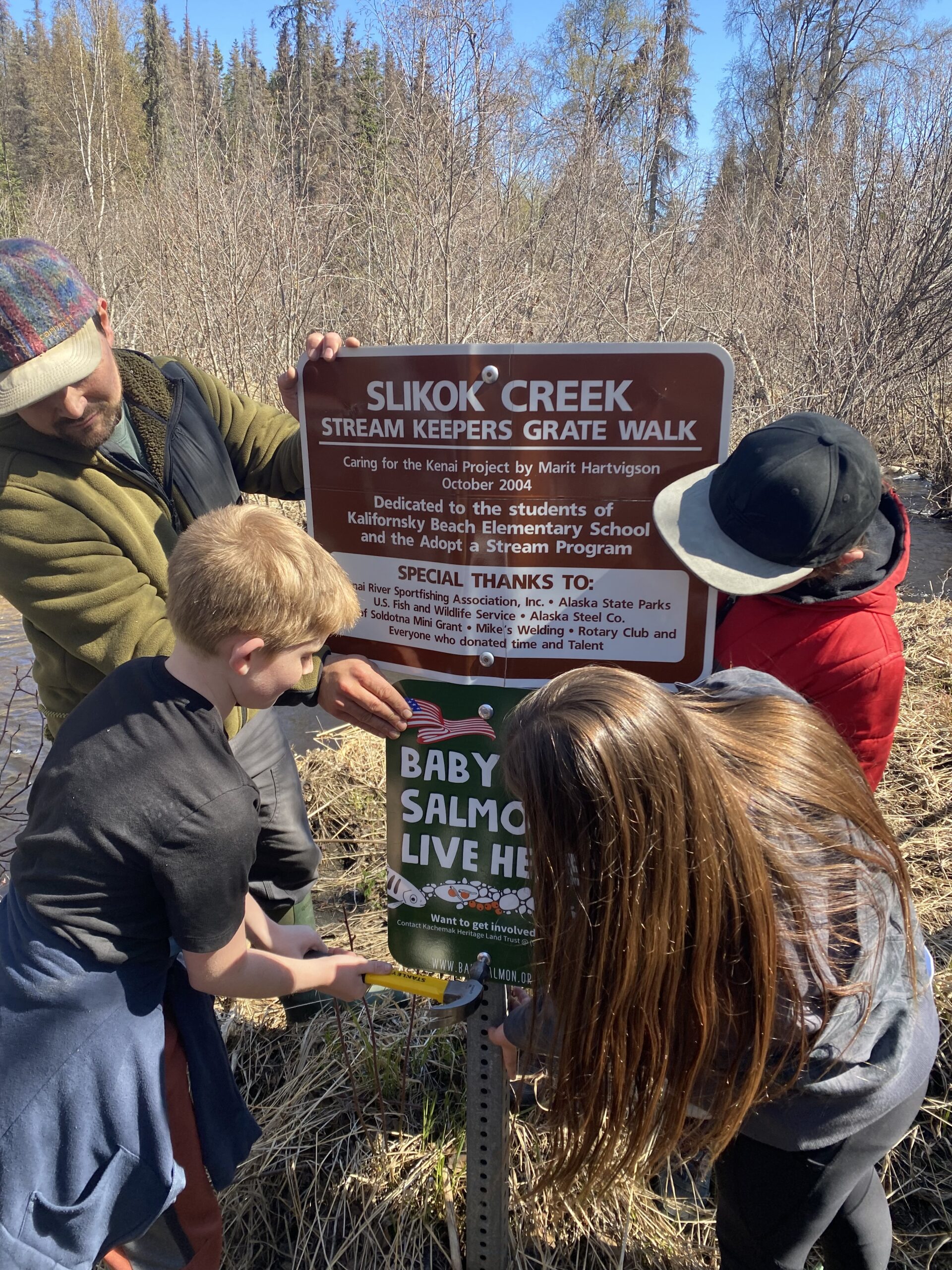
Baby Salmon Live Here!
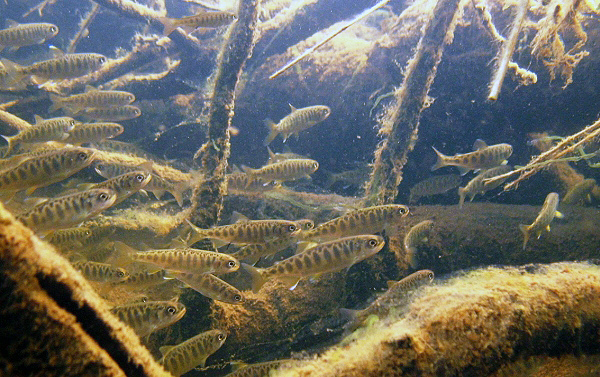
June 21, 2022One of the many great outreach works run by The Salmon Project was the “Baby Salmon Live Here” campaign. The campaign challenged us to recognize salmon habitat not only among the wide, clear rivers and lakes where adults leap up waterfalls, but also to see that just as much of their lives depend on the more humble, swampier, brushier parts of the watershed where juveniles (“babies”) grow up before departing to the ocean. The more we can recognize everyday salmon habitat under our own feet, the better job we can do keeping it intact. The campaign lives on today at www.babysalmon.org, and among the hundreds of green “Baby Salmon Live Here” signs posted throughout Alaska.
In summer 2022, we discovered a small stack of these signs that were yet to be posted and got to work with our partners to get them out into the world. We are working with local partners including Kachemak Bay Conservation Society, Center for Alaskan Coastal Studies, Cook Inletkeeper, and Kachemak Heritage Land Trust to deploy the remainder of these signs at places where salmon streams and lakes cross our roads and trails. Thanks also to the U.S. Fish & Wildlife Service for supporting creation of these signs.
For those of you ready to go put up signs, read on below!
A map of where existing signs are located, along with proposed sign locations can be viewed at an online map: Map of BSLH Sign Locations.
A spreadsheet of both existing and proposed sign locations can be viewed here: Spreadsheet of BSLH Sign Locations.
Instructions for how to install Baby Salmon Live Here signs at new locations can be found here: How to Install New BSLH Signs.
If you have an idea where to put a new Baby Salmon Live Here Sign, reach out to us at hydrology@kenaiwatershed.org ! Send us your pictures if you see a sign! And we are always looking for volunteers to help put them up!
Read the May 2022 local news article from KBBI.org here
Listen to the episode of Kachemak Currents about Baby Salmon habitat
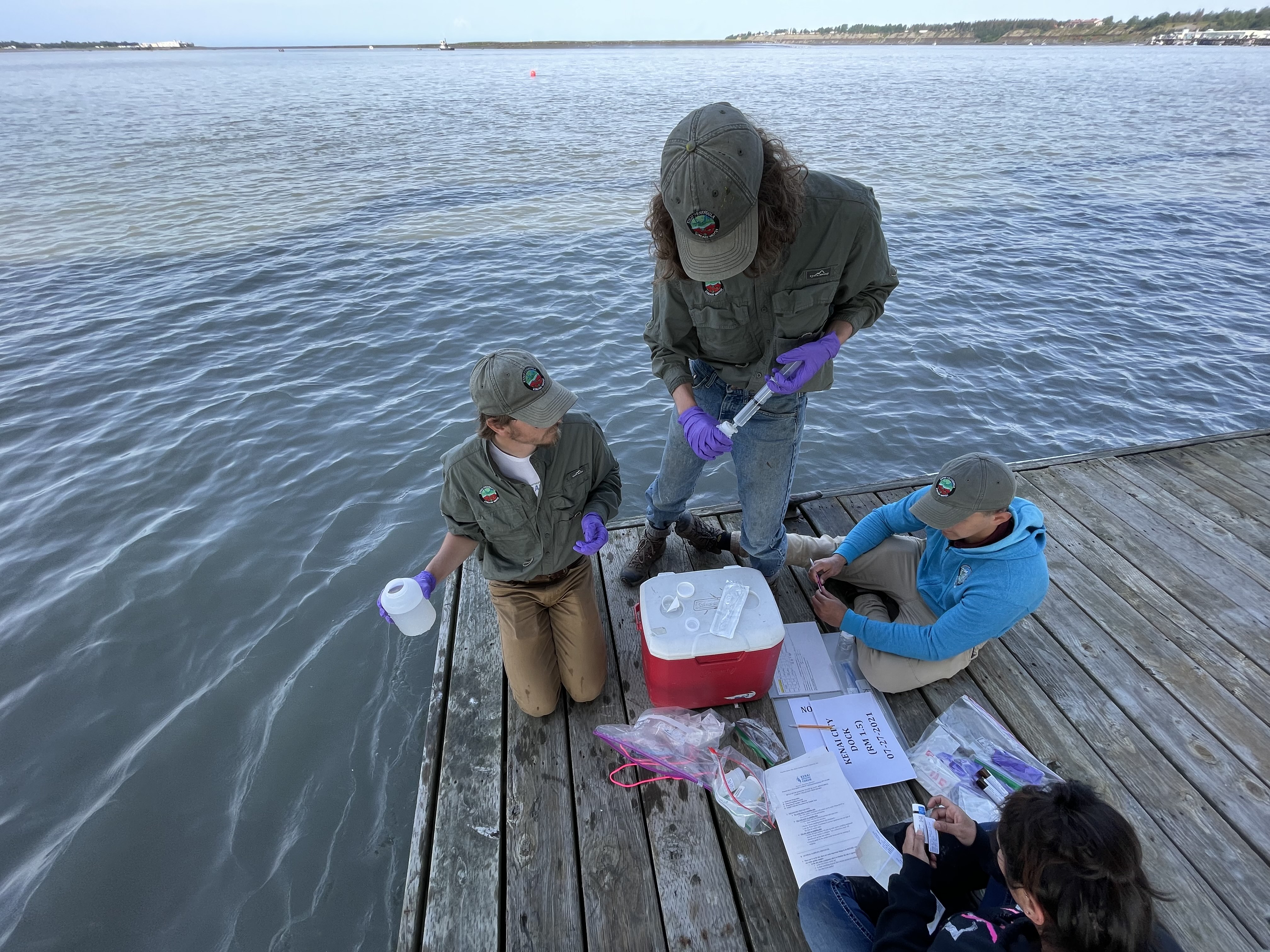
Spring 2022 Water Quality Sampling Results Available
May 24, 2022Kenai Watershed Forum has received all laboratory results from it’s Spring 2022 Baseline Water Quality Monitoring. The results are currently being prepared for upload to the Environmental Protection Agency’s Water Quality Exchange, a pubic data repository for water quality data. The results have not yet been analyzed to check against water quality standards; we expect to complete this by Fall 2022.
We worked with two laboratories in Spring 2022:
1.) Soldotna Wastewater Treatment Plant – SWWTP provided analyses of Total Suspended Solids and Fecal Coliform:
Download Spring 2022 Total Suspended Solids results
Download Spring 2022 Fecal Coliform results
2.) SGS Laboratories, Anchorage – SGS provided analyses of all other substances monitored in Spring 2022, including nutrients like phosphorus and nitrogen, and metals like zinc, copper, lead, and others:
Download Spring 2022 Metals and Nutrients results
For questions about Spring 2022 water quality results, contact Benjamin Meyer, Water Quality Coordinator. Thank you again to all the participants and volunteers who made this event happen!

The Kenai River Water Quality Action Framework
May 20, 2022In winter 2022, Kenai Watershed Forum began work on project called the, “Kenai River Water Quality Action Framework.” With this project we aim to give the Kenai River a “health check-up” by looking at water quality in the river. Using our extensive dataset from the year 2000 through to present day, our analysis will help understand where, when, and how water quality in the Kenai River has changed over time.
With financial support from the federal Bureau of Reclamation’s Cooperative Watershed Management Program, our work will address ongoing and emerging water quality issues and provide a roadmap for future management solutions. The project is an opportunity to provide the tools to help ensure that the Kenai River continues to serve as the keystone of the local economy, culture, and ecosystem long into the future.
Currently we are engaged in preparing our data for analysis. Our first product will be similar to a technical report published by Kenai Watershed Forum in 2016 summarizing water quality data (download the report here). From there we will apply these data towards understanding what steps to improve water quality are most urgent. For example, some new construction projects are incorporating green storm water infrastructure, which can help mitigate pollution from impervious surfaces like roads.
As we progress with our research, we plan to integrate other sources of water quality data to help us understand the most complete picture, such as the data set being generated by the Alaska Department of Environmental Conservation, a long standing partner of the baseline monitoring project.
The project will run through Fall 2023, and will include various public outreach activities at a later date. For more information on this project, contact Benjamin Meyer, Water Quality Coordinator.
Further Reading
Kenai River Baseline Water Quality Monitoring Quality Assurance Project Plan (QAPP) – This document outlines procedures for water quality field data collection, QA/QC procedures, and data management. The QAPP is currently (July 2022) in the process of being updated to incorporate new revisions.
Kenai River Baseline Water Quality Monitoring Sample Collection Procedures – This document details field sample collection procedures for water quality samples, and is updated annually.
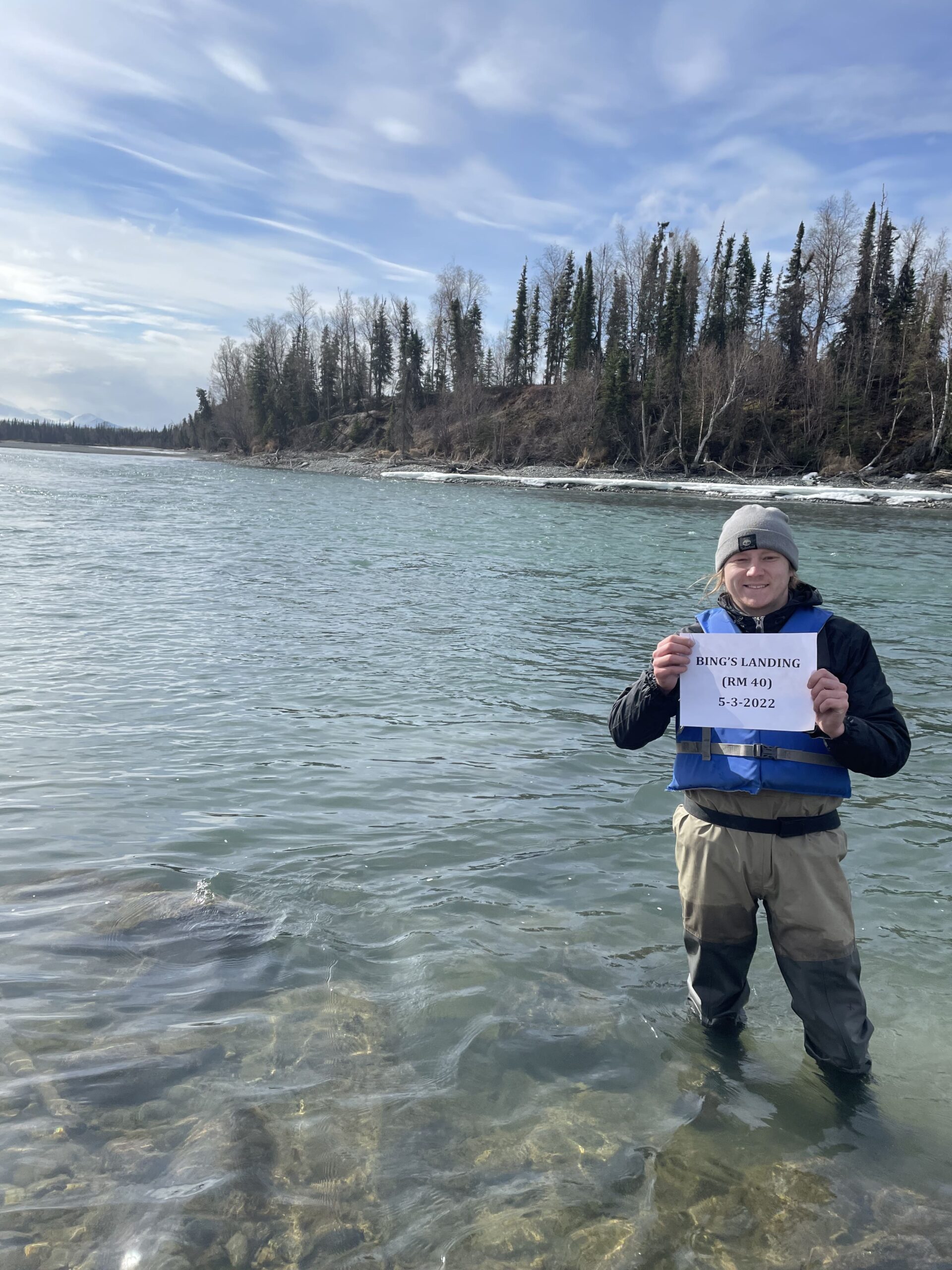
Kenai River gets spring health check-up
May 16, 2022Kenai Watershed Forum’s biannual Kenai River Baseline Water Quality Monitoring program was recently featured on our local public radio station KDLL. Spring 2022 marked the 22nd consecutive year of this program that works with community partners to gather water quality data, which helps identify both challenges and solutions for water quality in the Kenai River.
Thanks as always to reporter Sabine Poux at KDLL! Volunteers interested in this program can contact Water Quality Coordinator Benjamin Meyer.
Click here to listen to the story: https://www.kdll.org/local-news/2022-05-16/river-monitoring
Check out a short video from sampling day on our Kenai Watershed Forum Facebook Page!
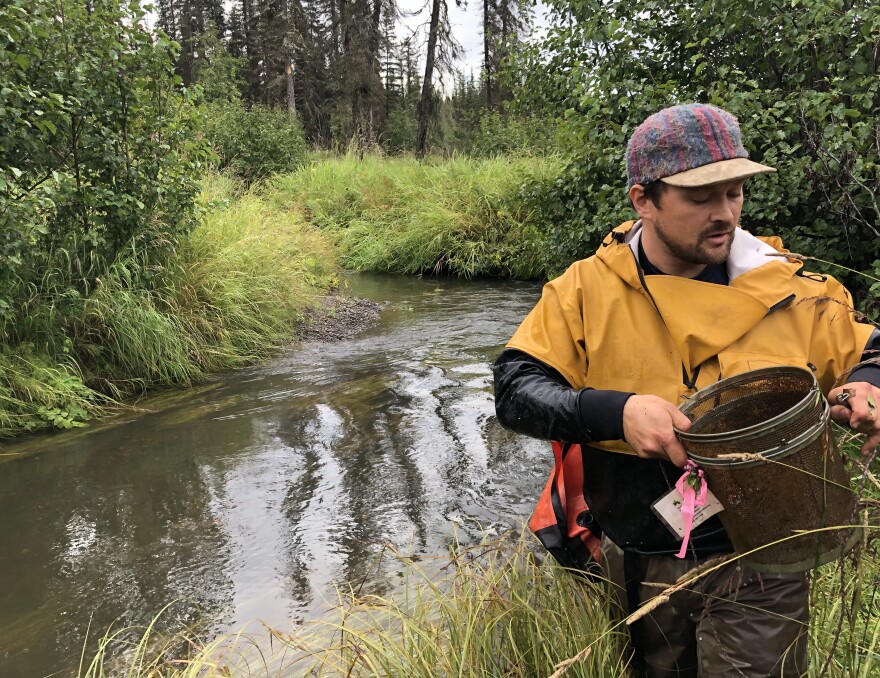
As local streams warm, cold water inputs could be crucial for salmon
May 12, 2022In summer 2021, KDLL public radio reporter Sabine Poux joined us a day of fieldwork at Beaver Creek, near the city of Kenai. Kenai Watershed Forum is working with other local nonprofits including Cook Inletkeeper and Kachemak Heritage Land Trust to identify and conserve cold water inputs important for salmon habitat in local streams like Beaver Creek.
We’d like to congratulate Sabine for her award on this story at the 2022 Alaska Press Club awards for “Best Audio Science Reporting.” Thanks for helping us share our work with the community!
Read the story at the link below:
Volunteers Needed for Salmon Habitat Mapping Research
May 11, 2022Kenai Peninsula Chapter of Trout Unlimited is partnering with Kenai Watershed Forum in summer 2022 to identify, map, and conserve undocumented salmon habitat in our area. We can use your help!
Join us for local fieldwork this summer. For dates and more information, contact Benjamin Meyer (Water Quality Coordinator) at ben@kenaiwatershed.org.